

Alpha School Highlights Swift Student Advancement Driven by Artificial Intelligence in Collaboration with State and Federal Leaders
On September 9, U.S. Secretary of Education Linda McMahon visited Alpha School in Austin with Texas Education Agency Commissioner Mike Morath. MacKenzie Price, co-founder of Alpha School, shared the school’s efforts to utilize AI for personalizing and enhancing student education.
“It’s the most exciting thing I’ve seen in education in a long time,” McMahon expressed regarding Alpha School. “I’m incredibly enthusiastic about this.”
How it operates
Alpha School was founded by Price in 2014 with the aim of offering customized, accelerated instruction along with life skills development beyond traditional academia, as she told Community Impact last year. Students engage in their academic learning for two hours a day using an AI platform called 2 Hour Learning.
This platform empowers students to learn at their own rhythm and progress through multiple grade levels in various subjects based on their individual performance. Price noted that the Alpha School model allows students to learn twice as quickly compared to conventional educational settings.
After finishing their academic responsibilities, students can attend workshops aimed at nurturing essential life skills like entrepreneurship, leadership, public speaking, and financial literacy. Last year, Alpha School inaugurated three specialized academies, which include a GT School for gifted students in Georgetown, the esports-focused NextGen Academy in Northwest Austin, and Texas Sports Academy located in the Lake Travis area.
These academies are managed by guides instead of traditional teachers, focusing primarily on inspiring students and offering emotional support.
“It’s time for us all to feel responsible for delivering better outcomes for these kids,” Price stated. “Leveraging artificial intelligence enables us to elevate human intelligence, not just for the students, but also for the teachers, guides, and families.”
The latest updates
This school year, Alpha School has opened multiple new academies across the U.S., including a K-3 institution in Plano and a K-8 educational facility in Fort Worth. The organization plans to establish an academy in Houston this winter, according to the Alpha School website.
Additionally, Alpha School has launched a virtual charter school in Arizona and is looking to open another charter school in Bastrop by 2026, as Price informed Community Impact in February.
Moreover, Alpha School has started collaborating with school districts to introduce its 2 Hour Learning platform in select public schools. The program has provided intervention and enrichment to 1,500 public school students across more than 50 districts, according to Gaston Griffin, a representative of Studient and a former guide at Alpha School.
“Our goal is for districts and schools to pilot this to experience this incredible opportunity and solution themselves,” Griffin said.
Feedback from students
One of the Alpha School students, Everest Nevraumont, shared that she moved from a fourth-grade to a ninth-grade reading level within a single school year using the 2 Hour Learning platform.
“In reading, I’m at a ninth-grade level, but in math, I’m at a fifth-grade level because I’ve progressed much faster in reading,” Nevraumont noted.
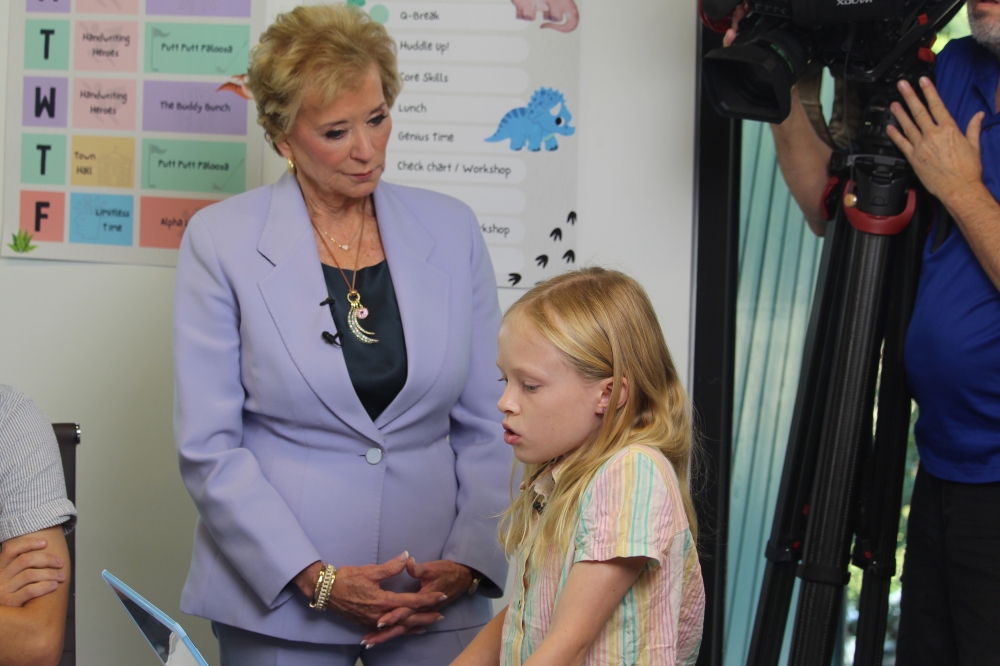
Christie Ray, an Alpha School guide and former public school principal, described witnessing students advance from pre-kindergarten to first-grade levels in just five months after implementing 2 Hour Learning at a struggling charter school.
“This offers the chance to restore what has been lacking in education, which is the love of school and the love of learning,” Ray remarked. “This is what we achieved with students from the failing charter school, allowing them to take charge of their own learning.”
Noah Lightfoot transitioned from his teaching role at Dripping Springs ISD to become a guide at Alpha School. He expressed that he has been able to build deeper connections with his students and inspire them to learn through their individual interests.
A broader perspective
McMahon, who took office as Secretary of Education in March, expressed enthusiasm for observing Alpha School’s AI model and its potential to transform the functioning of schools across the nation. She emphasized that teachers thrive when they can innovate within their classrooms.
“Let’s motivate our states and school systems to be curious enough to understand what is happening here,” McMahon stated. “If I achieve that, we will significantly improve our education system.”
During the 2025 legislative session, state lawmakers allocated $1 billion to establish education savings accounts (ESAs), which families can use for private school tuition and various educational needs. The majority of participating students will receive 85% of the per-student funding that public schools receive from state and local sources—approximately $10,330 in the program’s first year, based on prior Community Impact reports.
The tuition fees for Alpha School campuses range from $10,000 to $40,000 per year, Price noted. Community Impact inquired whether she was optimistic that the new ESA program, effective next school year, would broaden access to Alpha School academies for more families in Texas.
“Absolutely,” Price affirmed. “[With] more opportunities for families to enter private education [and] the support from ESAs, it will open doors for many.”
Alpha School continuously evaluates students to identify their learning needs and create tailored lesson plans, according to Price. The organization utilizes AI to track students’ learning progress.
House Bill 8 aims to abolish the State of Texas Assessments of Academic Readiness and substitute it with three concise tests, which students will take at the start, middle, and conclusion of each academic year. State legislators passed the bill and forwarded it to the governor on September 3.
“Many of the concepts discussed today are part of the new system we will roll out in the 2027-28 school year here in Texas,” Morath commented on standardized testing during the Alpha School event on September 9.
